Introduction
In the world of industrial displays, “one size fits all” is a myth. For project managers and engineers, choosing between a Standard Display and a Wide Temperature Display isn’t just about price—it’s about the survival of your equipment in the field. At TopLink, we’ve seen how temperature fluctuations can compromise a kiosk’s uptime. This guide breaks down the technical nuances you need to know.
I. The Core Technical Differences
The difference lies deep within the liquid crystal material and the backlight architecture.
Liquid Crystal Fluid: Standard panels use LC fluids that may crystallize at low temperatures or turn into an “isotropic” (dark/opaque) state at high temperatures. Wide-temp panels utilize specialized fluid mixtures that remain stable from -30°C to +85°C.
The Backlight System: Standard LEDs are designed for climate-controlled environments. Wide-temp displays feature enhanced thermal management and high-efficiency LEDs that prevent “yellowing” or dimming even after thousands of hours in high-heat enclosures.
II. Operating Temperature Range: The Core Difference
| Panel Type | Operating Temperature | Storage Temperature |
|---|---|---|
| Standard LCD | 0°C ~ 50°C | -10°C ~ 60°C |
| Wide-Temperature LCD | -30°C ~ 80°C (typical) | -40°C ~ 85°C |
Standard panels are designed for office or indoor commercial environments. Once the panel temperature drops below 0°C, the liquid crystal molecules lose mobility, causing sluggish image response and even partial freezing of pixels.
Wide‑temperature panels utilize specially formulated liquid crystal materials and optimized TFT driving circuits to maintain stable molecular alignment across extreme thermal ranges.

At low temperatures, conventional LC material becomes viscous, which leads to:
Severe response delay
Image trailing / smearing
Large-area black patches (temporary LC freezing)
Color temperature drift toward yellow
Wide‑temperature LC compounds have lower crystallization points and maintain fluidity even at -30°C, allowing:
Stable pixel switching
Uniform brightness distribution
Consistent color reproduction
No permanent damage after cold start
III. Why It Matters: The “Blackout” Phenomenon
Have you ever seen an outdoor digital sign turn black in the afternoon sun? That is Solar Loading. Standard displays cannot dissipate heat fast enough, causing the liquid crystals to lose their orientation. A TopLink Wide Temperature Display incorporates advanced heat dissipation and high-Tni liquid crystals, ensuring your content remains visible even under direct sunlight and extreme summer heat.
Standard LCD backlights rely on typical LED bins optimized for room temperature.
In sub-zero conditions:
LED luminous efficiency drops sharply
White balance shifts significantly
Power consumption increases due to over-driving
Backlight lifespan is reduced by over 40%
Wide‑temperature displays use:
Industrial-grade LED bins
Temperature-compensated current driving circuits
Anti-condensation optical cavity design
This ensures stable luminance output from deep winter to high‑heat summer environments.
Optical Performance Comparison in Outdoor Use
(These are not laboratory theoretical values, but field data collected from logistics terminals, parking kiosks, and industrial HMI projects.)
| Parameter | Standard LCD | Wide-Temperature LCD |
|---|---|---|
| Cold start time at -20°C | 8–15 minutes | Instant |
| Low-temp black spot risk | Very high | None |
| Color stability | Poor | Excellent |
| Brightness retention | -30% to -45% | <5% loss |
| Image ghosting | Severe | None |
IV. TopLink’s Factory Advantage: Testing for Extremes
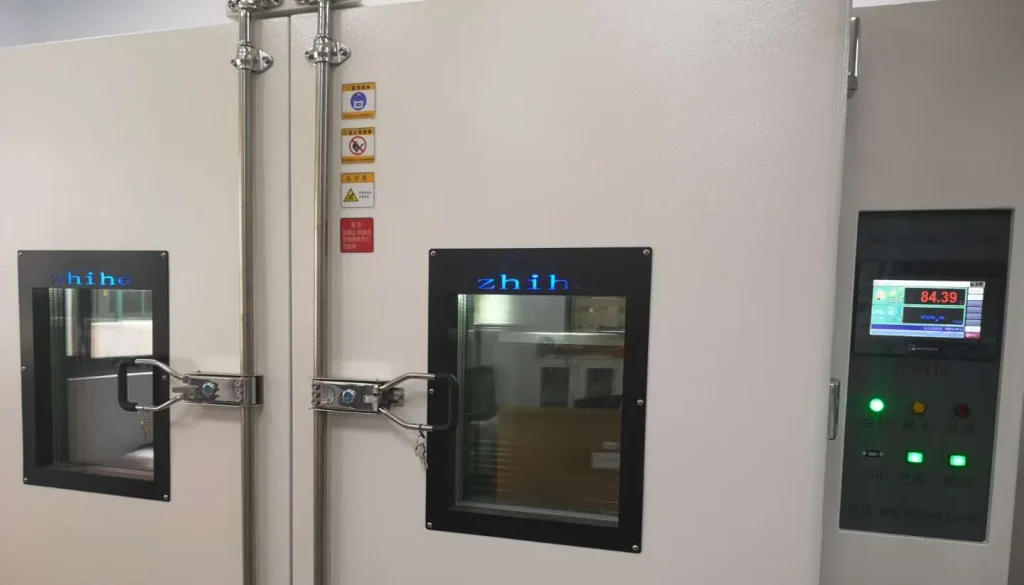
As a manufacturer, we don’t just take the panel’s word for it. Every wide-temp monitor at TopLink undergoes:
High/Low Temp Soaking: 24-hour testing in our environmental chambers.
Thermal Shock Test: Rapidly cycling between -30°C and 80°C to ensure bond integrity.
Optical Bonding (Optional): We recommend optical bonding for wide-temp units to eliminate the air gap where condensation usually forms.
Lifetime Degradation
Operating standard panels outside their temperature specification accelerates:
LC molecular breakdown
Polarizer aging
Driver IC electromigration
Backlight phosphor degradation
In real projects, standard LCD lifetime drops from 50,000 hours to less than 15,000 hours in outdoor environments.
Wide‑temperature LCDs maintain rated lifespan even under continuous thermal cycling.
Application Risk Analysis
| Application Scenario | Standard LCD Risk | Wide-Temperature LCD Risk |
|---|---|---|
| Outdoor kiosks | High failure rate | Negligible |
| Cold storage terminals | Unusable | Fully functional |
| Traffic control cabinets | Frequent black screen | Long-term stable |
| Renewable energy field systems | High maintenance cost | Maintenance-free |
V. Conclusion
Choosing between standard and wide‑temperature LCD is not a question of brightness or marketing labels — it is a decision that determines system reliability, maintenance cost, and customer satisfaction.
For any environment exposed to:
Temperature below 0°C
Direct sunlight heating
Large day-night thermal fluctuations
Wide‑temperature LCD is not an upgrade — it is a requirement.